From Product Theory: The Hidden Forces That Shape User Behavior — 40+ short chapters on why users behave the way they do.
A real estate agent shows you a house priced at $800,000. It's nice, but not quite right.
The next house is $650,000. Same neighborhood, same size. You feel like you're getting a deal.
You're not evaluating the second house on its merits. You're evaluating it against the first number that entered your head.
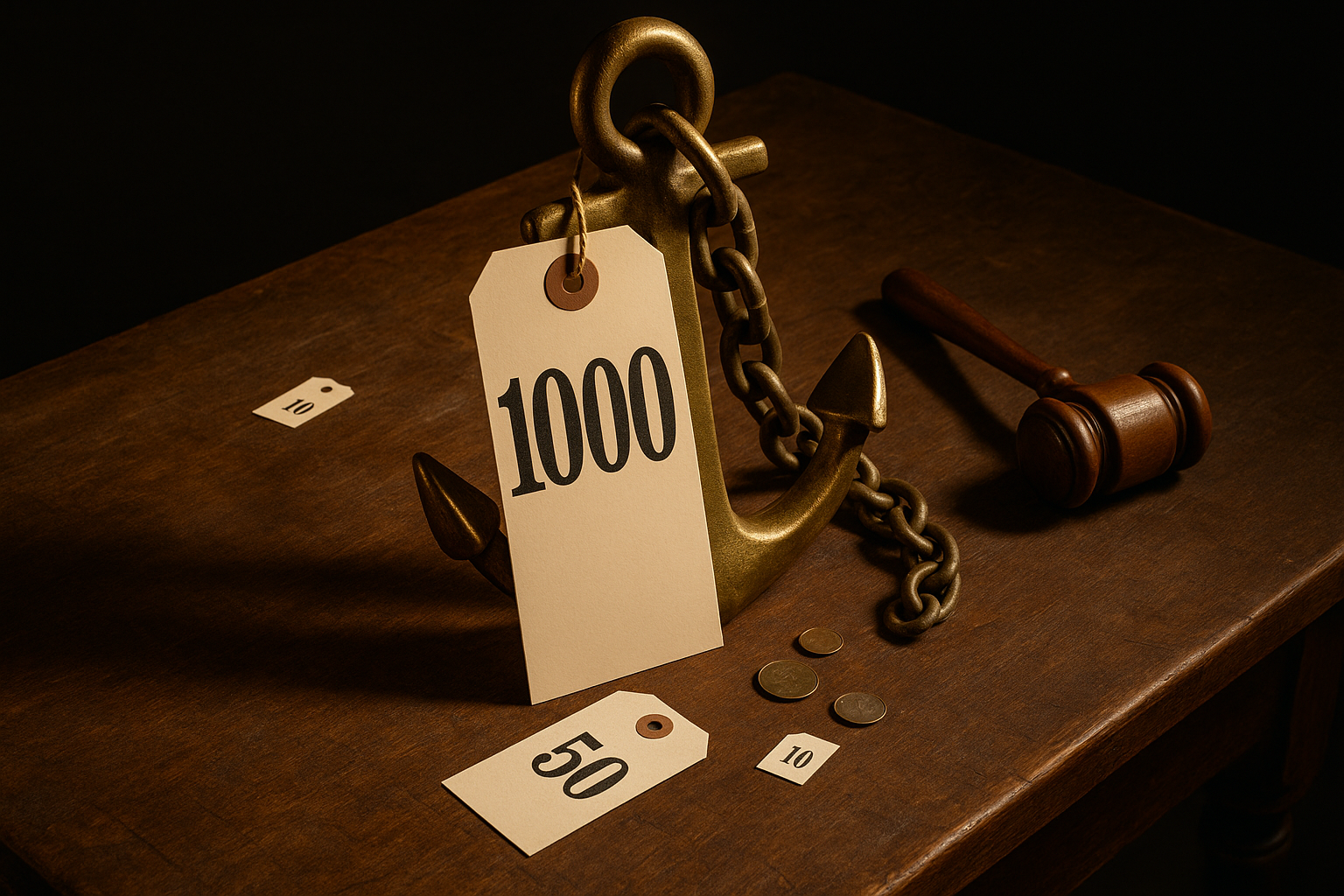
That's anchoring — and once you see it, you can't unsee it in your own pricing page.
Your brain doesn't do absolute value
Here's the uncomfortable truth: your brain almost never asks "what is this actually worth?" That calculation is hard. It requires context, comparison, math. So your brain cheats. It grabs whatever number is already in front of it and adjusts from there.
The problem is that we don't adjust enough. The starting number drags our final estimate toward it — even when the starting number is complete nonsense.
In the 1970s, Amos Tversky and Daniel Kahneman proved exactly how little that number has to mean. They spun a wheel of fortune, rigged to land on either 10 or 65, in front of participants. Then they asked a totally unrelated question: "What percentage of African countries are in the United Nations?"
People who saw 65 guessed higher. People who saw 10 guessed lower.
A random, meaningless number — one they'd just watched a wheel land on — changed their answer to a factual question. These weren't foolish people. The anchor worked anyway. It works on you too.
The salesperson who anchors on purpose
Watch how a good salesperson uses this. Notice that nobody says a false number — they just choose the order the numbers arrive in.
Seller: "Similar projects typically run $50,000 to $75,000." Sets the anchor high.
Buyer: "That's more than we budgeted."
Seller: "Given your timeline, we could do a focused version for $35,000." Suddenly reasonable.
Buyer: "That could work." Comparing to the anchor, not to absolute value.
The $35,000 felt like a deal. And here's the kicker: it may have been the target price all along. The seller never lied. They just made sure the first number was theirs.
Where anchoring lives in your product
You are setting anchors whether you mean to or not. The only question is whether you're doing it deliberately.
Show the higher number first
If you have pricing tiers, lead with the expensive one. The $99/month plan looks reasonable after the reader has already absorbed the $299/month enterprise tier. Reverse the order and $99 suddenly feels like a stretch — same plan, same features, different first impression.
Tell people what "normal" looks like
"Most customers choose the Pro plan" isn't just social proof. It's an anchor. You've defined the center of the range. Now Basic feels a little cheap, Enterprise feels a little indulgent, and Pro feels like the sensible adult choice — which is exactly where you wanted them.
Handle discounts like a loaded gun
A "50% off" tag establishes that a full price exists somewhere out there. Used well, it creates a real sense of savings. Used carelessly, it teaches people your product isn't worth full price.
And discount constantly, and your users will anchor to the discounted number. The "real" price becomes a fiction nobody believes — a problem every perpetually-on-sale retailer knows too well.
Why it works, in one sentence
Your brain evaluates nothing in a vacuum. It needs a reference point, and it will use whatever reference point is closest to hand.
When you see a $200 shirt marked down from $400, you aren't thinking about whether the shirt is worth $200. You're thinking about the $200 you're "saving." The $400 is meaningless — the shirt was never going to sell for that. But your brain latched onto the first number it saw and built the whole story around it.
Rule of thumb: The first number wins. Make sure it's yours.
This is one of the cheapest levers in product and pricing, because it costs nothing to reorder a page or lead with a range. You're not manufacturing value. You're just refusing to let a random number — a competitor's price, a user's imagined budget, a stray figure from a review — set the reference point for you.
If you're already squinting at your own pricing page, wondering which number your users see first, that's the idea doing its work. I send one more like it every week — you can get them here.