From Customer-Led Development: How to Build What Your Customers Want When AI Can Build Anything — the operating manual for building what customers want when AI can build anything. See every chapter.
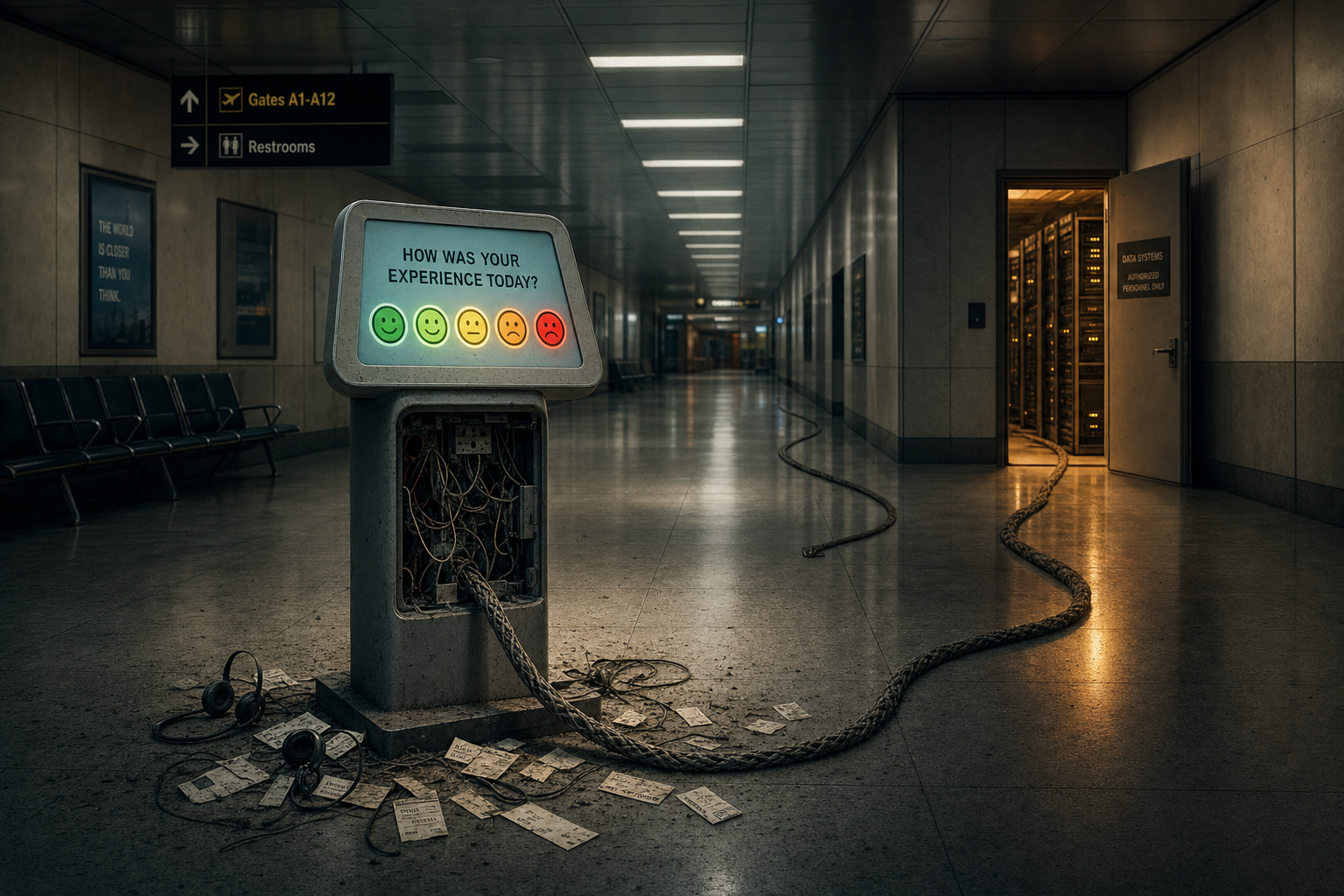
Just past airport security, there's often a little kiosk with five smiley faces, from a green grin on the left to a red scowl on the right. You tap one on your way to the gate. Look closely next time. A surprising number of them aren't plugged into anything.
That kiosk is the best metaphor I know for how most companies handle their customers. Feedback goes in. Nothing comes out.
The kiosk works, just not for the company
Here's the strange part. Even unplugged, the kiosk isn't useless. It does something real for you.
Naming how you feel, whether you liked something or hated it, measurably calms you down. In a UCLA neuroimaging study, Lieberman et al., "Putting Feelings Into Words" (Psychological Science, 2007), researchers found that labeling an emotion dampens the brain's threat response. You tap the red face, and some of the tension leaves your body. You move on.
So the kiosk serves the customer. It's the company that gets nothing. A signal was sent, a person was briefly heard, and the organization learned exactly zero.
That gap, between a customer who spoke and a company that didn't listen, is where most products quietly fail.
You already have the data
Think about the last time you called a company and heard, "This call may be recorded for quality assurance." You know, and they know, that nobody is reviewing that call. There are thousands of them. There's simply too much.
Meanwhile, the same company is in a conference room, desperately trying to answer the questions that decide whether it survives:
- Who should we care deeply about?
- What should we build?
- Why should we build it?
- Who are we building it for?
- How do we position it and get it to market?
The answers are sitting in the recordings, the tickets, the sales calls, the churn notes. The company isn't short on information. It's drowning in it.
Companies have all the data and all the knowledge they need to solve customer problems, and no scaffolding to act on any of it.
That's the failure customer-led development exists to fix. Not a lack of customer obsession. Most teams reading this already care. The problem is that caring doesn't come with a structure. Nobody knows where to start, or what to do next.
Center, not bookends
Most companies that call themselves customer-focused actually treat the customer like bookends. There's a burst of discovery at the start of a project. There's a satisfaction survey at the end, if you're lucky. Everything in between is driven by roadmaps, deadlines, and the loudest voice in the room.
| Where the customer sits | What it looks like | What you lose |
|---|---|---|
| At the start | Kickoff interviews, a persona doc, then heads-down building | Everything you learn after week two |
| At the end | NPS surveys, launch feedback, the kiosk | The chance to change anything before it ships |
| At the center | Customer signal shapes decisions continuously | Mostly your excuses |
Customer-led development means moving the customer from the edges of the process into the middle of it. And for the first time, that's actually achievable. The same AI shift that lets teams build almost anything also makes it possible to finally hear what's in those thousands of unreviewed calls. That combination changes the math on what a company can afford to pay attention to.
Nobody is pure anything
Before this sounds like a new religion, a confession. In conversations with more than 2,000 product leaders, founders, CTOs, and engineers, I've never met a company that was purely agile, or purely waterfall. I've never met one that was only sales-led, only engineering-led, or only customer-led.
Organizations live on a spectrum. There are moments to be engineering-led, like when the hard problem is genuinely technical. There are moments to be sales-led, like when a market window is closing. Pretending otherwise is how methodologies turn into dogma.
Rule of thumb: Don't ask "are we customer-led?" Ask "where is the customer sitting in this decision: the start, the end, or the center?"
Customer-led isn't the only way to build a financially successful product. It's a tool. I'd argue it's the best tool for continuing to build well over time, because it's the one that compounds. Every decision made closer to the customer makes the next one easier.
What this won't do
One honest caveat. If your leadership doesn't already value customers, no essay or book will convert them. Customer-led thinking won't hand you enough ammunition to win that argument from scratch.
What it can do is help the teams who already care stop leaking signal. It can give you the confidence to make hard calls, and the evidence to bring the people around you along.
Plug the kiosk in
The airport kiosk tells you something hopeful. People want to tell you how they feel. They'll do it even when nobody's listening. The willingness is already there.
Your job isn't to collect more feedback. It's to plug in the feedback you already have, and build the scaffolding that turns a tapped red face into a decision someone actually makes.
For the full system, from deciding who to care about to turning raw customer signal into what you build next, read Customer-Led Development.
If you want more ideas like this one, about closing the gap between what customers say and what companies do, subscribe to the Context Limit newsletter.