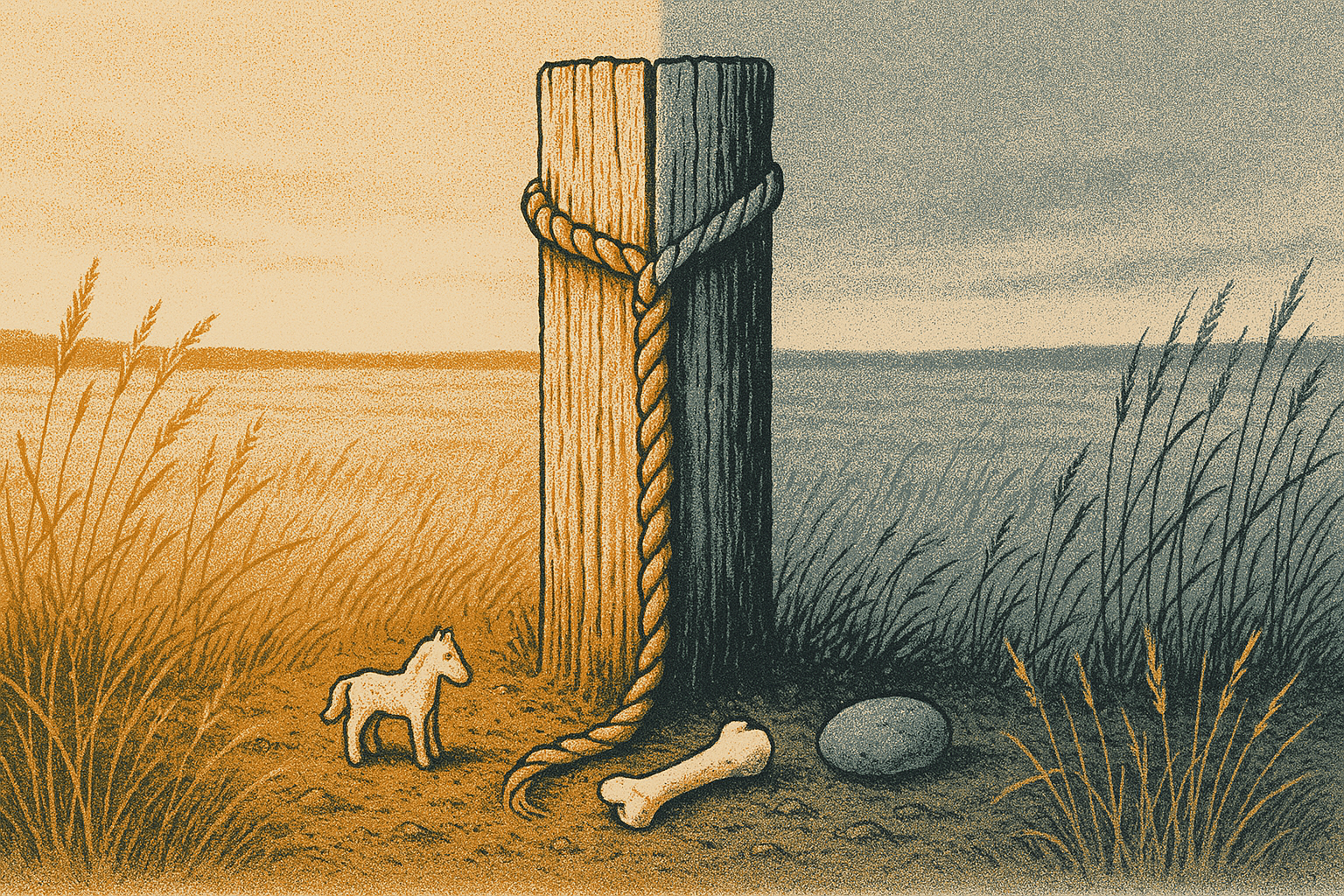
From Words: Fables, Parables, and Wisdom for Modern Life — 200+ wisdom stories, organized by the moment in life you'll need them.
The day something goes wrong, you want a verdict. Good or bad. Fixed or ruined. Your fault or theirs. The mind grabs for a label so it can stop hurting.
But the oldest stories we tell each other about hard times all point the same direction: the verdict is the mistake. You don't have enough information yet. You almost never do.
Here are three of them — from three traditions, across a couple thousand years — for the next time the floor drops out.
1. The Farmer Who Refused to Panic
An old farmer lived near the northern border, and one day his horse ran off. The neighbors came around, shaking their heads. "Terrible luck," they said.
"Maybe," the farmer said. "Maybe not."
Months later the horse came home — and brought a wild stallion with it. The neighbors returned, delighted. "How wonderful!"
"Maybe. Maybe not."
His son loved the new horse, rode it, got thrown, and broke his leg. The neighbors offered sympathy. "Such bad luck." The farmer said the same thing he always said.
A year later, the northern tribes invaded. Every able-bodied young man was conscripted, and nine in ten died in the fighting. The farmer's son, with his broken leg, stayed home. Father and son survived together.
Origin: a Taoist story from the Huainanzi, an ancient Chinese text (c. 139 BCE).
The lesson is not that everything works out. Sometimes the leg just breaks and nothing good comes of it. The lesson is smaller and more useful: you are judging a story you're standing in the middle of. Good fortune and bad fortune are braided together, and the ends are out of sight.
Rule of thumb: When you catch yourself declaring an event "the worst thing that could happen," add the farmer's two words — "maybe not" — and keep moving.
In modern life this shows up constantly. The job you didn't get. The relationship that ended. The launch that flopped. Ask anyone a decade past their worst year and they'll often trace their best thing straight back to it.
2. The Monk Who Said "Is That So?"
Hakuin was a respected Zen master living beside a village. A young woman there got pregnant, and when her parents demanded a name, she panicked and named Hakuin — protecting the man she actually loved.
The village turned on him overnight. His reputation, built over decades, collapsed. His students left. When the baby was born, the furious parents dumped it at his door: "You're the father. You raise it."
Hakuin said only, "Is that so?" And he took the child in, and cared for it tenderly through a year of public disgrace.
Eventually the young mother couldn't carry the guilt anymore and told the truth — a local fisherman was the father. The parents rushed back, apologizing, begging forgiveness. Hakuin handed the baby back with the same two words he'd used at the start.
"Is that so?"
Origin: a Japanese Zen story, attributed to the master Hakuin Ekaku (1686–1769).
What's easy to miss is that Hakuin's calm wasn't passivity. He accepted the blame and he raised the child well. He simply refused to let the crowd's opinion decide who he was. Praise and blame arrived at his door wearing the same clothes, and he treated them the same.
True peace does not come from clearing your name. It comes from no longer needing to.
Most of our suffering when things go wrong isn't the event — it's the audience. What they'll think. How it looks. The story getting away from us. Hakuin's answer is a quiet form of freedom: do the right next thing, and let the verdict sort itself out.
3. The King and the Ring
There was once a king who lived on a pendulum. Good news sent him soaring; the smallest setback dropped him into despair. His moods ran the whole kingdom ragged.
A wise adviser gave him a plain ring with words engraved inside: This too shall pass. Wear it always, he said. Read it whenever you feel swept away — in either direction.
So the king did. In hard times, the ring reminded him the trouble was not permanent, and hope crept back. In triumphant times, it tempered the high — reminding him to hold his good fortune with gratitude instead of gripping it. Over the years, the man steadied. He found joy in ordinary days and calm in turbulent ones. And the kingdom, watching him, steadied too.
Origin: a folk tale with Persian and Jewish roots, often tied to the wisdom tradition of King Solomon.
Notice the ring cuts both ways. Most people want impermanence to comfort them in grief but exempt their joy. It doesn't work like that. The same truth that says "this pain will end" also says "this happiness will end" — and that's not bleak. It's what makes a good day worth savoring instead of hoarding.
| Story | The trap | The medicine |
|---|---|---|
| The Farmer's Horse | Judging events too early | "Maybe. Maybe not." |
| Is That So? | Living for the crowd's verdict | Do the next right thing; let opinion pass |
| The King and the Ring | Being ruled by your moods | "This too shall pass." |
What the Three Have in Common
Read together, these stories aren't telling you to fake positivity or to feel nothing. They're pointing at something subtler: the gap between an event and your judgment of it.
The farmer widens that gap in time — you can't grade the day from inside it. Hakuin widens it in ego — the event doesn't have to touch who you are. The ring widens it in perspective — nothing, good or bad, stays.
Rule of thumb: When something goes wrong, delay the verdict. You will almost always be wrong about what a thing means the moment it happens.
You don't have to become a Zen master or a Taoist sage to use this. You just have to remember, on the worst afternoon of the month, that you're holding an unfinished story — and finishing it early is the one mistake all three heroes refused to make.
If this makes you slower to hand down a verdict the next time something goes wrong — even just long enough to say "maybe not" — that's plenty. And if you'd like the next idea to find you while the story's still unfinished, you can subscribe to Context Limit.