From Words: Fables, Parables, and Wisdom for Modern Life — 200+ wisdom stories, organized by the moment in life you'll need them.
Most choices don't feel like choices. They feel like weather — something that happens to you. You drift into the easy option, dwell on the one you already made, or miss the small good thing in front of you because you're too busy deciding.
These three stories are old. Greek, Zen, Japanese — separated by centuries and oceans. But they circle the same moment: the instant you have to pick. Here's each one, retold, and what it still has to say.
1. Hercules at the Crossroads
Greek. Attributed to Prodicus of Ceos, 5th century BCE.
Young Hercules, old enough to choose his life but not yet living it, went off alone to think. He sat at a fork in the road, unsure which way to go.
Two women appeared. The first was soft, beautifully dressed, her eyes full of promise. "Follow me," she said, "and I'll take you down the easiest, sweetest road. No labor. No hardship. Every pleasure, yours." He asked her name. "My friends call me Happiness," she said. "My enemies call me Vice."
The second woman was quieter. "I won't lie to you," she said. "My road is hard. You'll face trials that seem impossible. But you'll become what you were meant to be — and at the end, your life will have meant something." Her name was Virtue.
Hercules looked at them both for a long time. Then he stood, and followed Virtue.
The lesson
The easy path and the worthy path are rarely the same road. What you pick at the crossroads decides everything downstream.
Notice the sleight of hand: Vice introduces herself as Happiness. That's the whole trick. The tempting option almost never shows up labeled "bad choice." It shows up labeled "fine," "reasonable," "just this once." The work of choosing well is mostly the work of reading the second name behind the first.
Rule of thumb: when a choice feels frictionless, ask what it's really named.
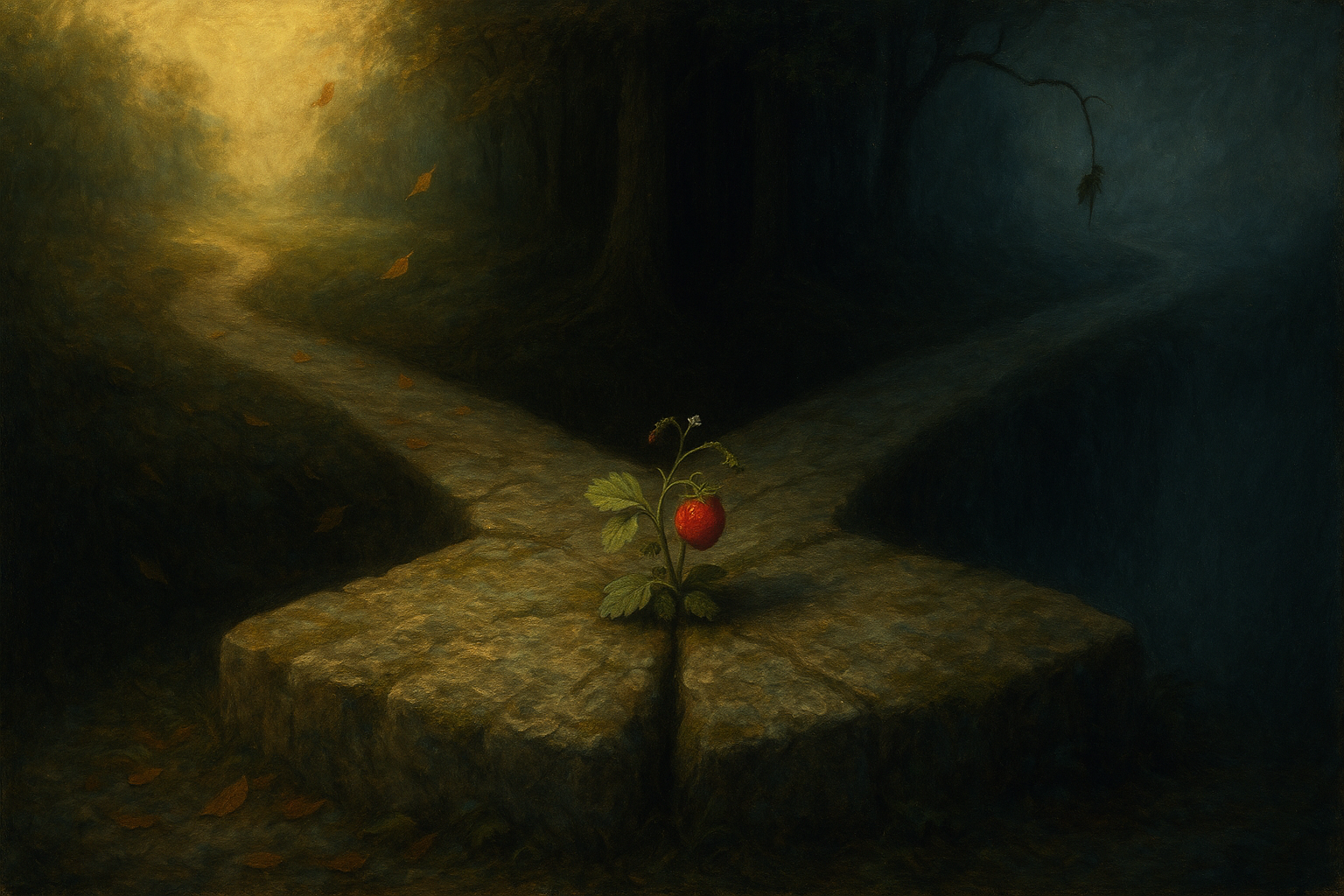
2. The Tiger and the Strawberry
Zen. Traditional.
A man crossing a forest met a tiger and ran. He reached a cliff and grabbed a vine, swinging himself over the edge to escape. Hanging there, he looked up — the tiger waited above. He looked down — another tiger waited below. Then he noticed two mice, one white and one black, gnawing at the vine.
And there, growing from the cliff face within arm's reach, was a wild strawberry.
He plucked it. He ate it. How sweet it tasted.
The lesson
You are the man on the vine. Behind you, the past; below you, whatever comes next; and time — the white mouse and the black, day and night — quietly chewing through the thread that holds you.
This story looks like it's about death. It's actually about attention. The choice here isn't which tiger to fear. It's whether, in a situation you can't control, you can still notice the strawberry.
The tigers aren't going anywhere. The mice won't stop. The only real choice you have is where to put your attention while you hang there.
Modern life is a slow version of the vine. There's always a tiger above (what went wrong) and a tiger below (what might). The people who seem well are not the ones with fewer tigers. They're the ones who still taste the strawberry.
Rule of thumb: you can't always choose your situation, but you can almost always choose what you attend to inside it.
3. Two Monks and the Woman
Japanese Zen.
Two monks walked a muddy road after heavy rain. Around a bend they found a young woman in a fine silk kimono, stranded at a muddy crossing she couldn't pass without ruining her clothes.
Without a word, the older monk lifted her, carried her across, set her down on the dry side, and walked on.
The younger monk stewed. Mile after mile, his face darkened. Finally, near evening, it burst out of him: "We're monks! We've taken vows — we don't touch women. How could you carry her like that?"
The elder turned, mildly surprised. "I set her down hours ago," he said. "Why are you still carrying her?"
The lesson
Once a moment has passed, put it down. Turning a decision over long after it's made doesn't undo it — it just means you're the one still hauling the weight.
The younger monk made a choice too, though he never noticed it. He chose to keep carrying. Most of us do the same with old arguments, small regrets, and the version of a conversation where we finally said the right thing. The decision was never the problem. The gripping was.
Rule of thumb: a choice you keep re-litigating is a choice you never actually finished making.
What the three have in common
Read together, they map the full arc of choosing — before, during, and after.
| Story | The moment | The choice it asks of you |
|---|---|---|
| Hercules | Before | See past the easy label to the real name |
| The Strawberry | During | Choose where your attention lives |
| The Two Monks | After | Set it down and keep walking |
Choosing well isn't one heroic act at a fork in the road. It's three quieter habits: seeing clearly before, staying present during, and letting go after. Hercules gets the glory, but the monk who set the woman down and the man who tasted the strawberry knew something he'd spend a lifetime of labors learning.
The next time you're stuck at your own crossroads, you don't need a better map. You need to name the roads honestly, notice the strawberry while you hang there, and — whatever you pick — put it down after and keep walking.
If one of these stayed with you — the second name behind the first, or the strawberry still within reach while you hang there — you can subscribe to the Context Limit newsletter, and I'll send along the next idea worth keeping.