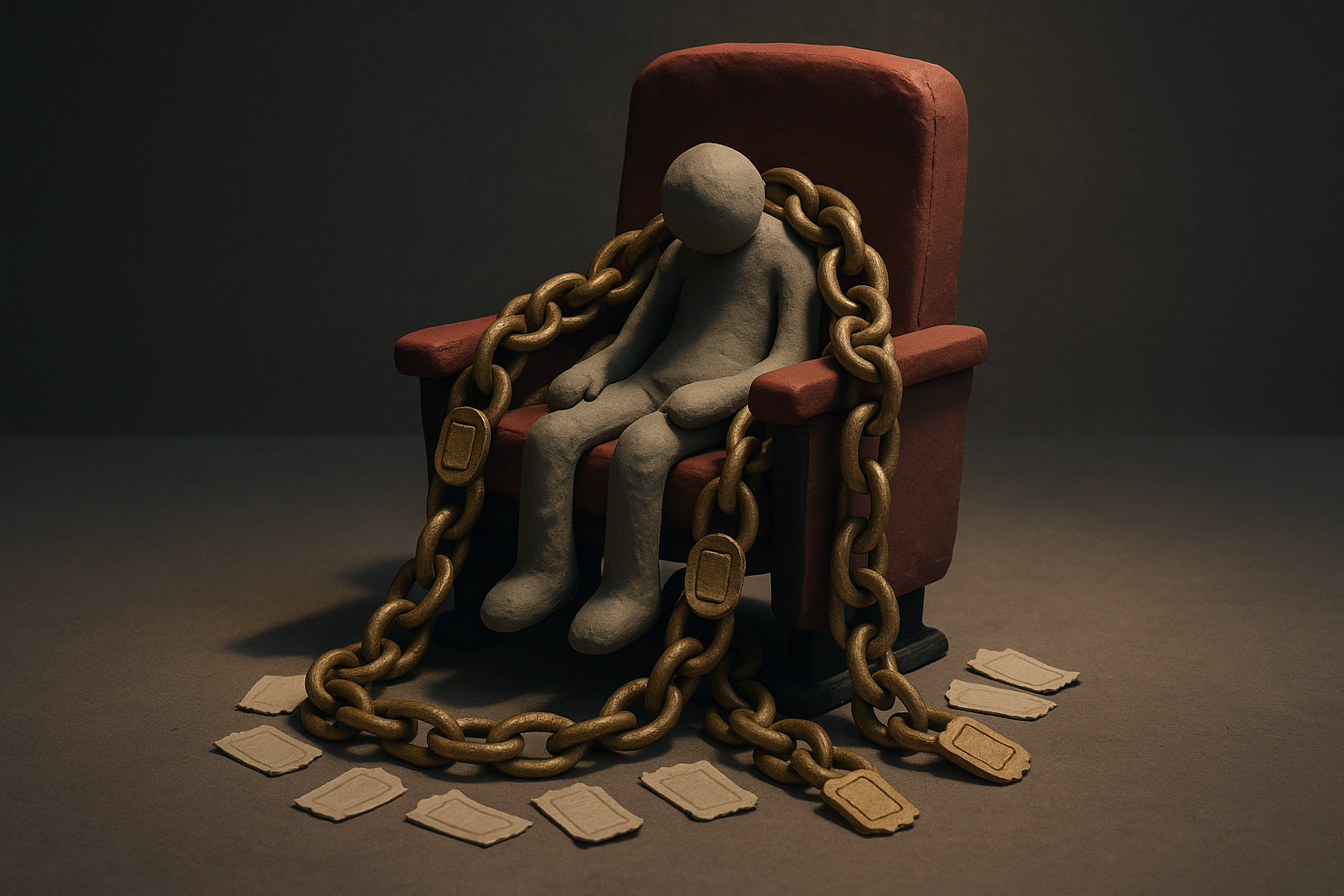
From Product Theory: The Hidden Forces That Shape User Behavior — 40+ short chapters on why users behave the way they do.
You're an hour into a bad movie. You know it's bad. It's not getting better.
Do you leave?
Most people don't. They stay because they've already spent the hour. Walking out would mean "wasting" it. But the hour is already gone. Staying doesn't recover it — staying just wastes another hour on top of the one you already lost.
That's the sunk cost fallacy: the accumulated weight of past investment bending a decision that should only care about the future. And if you build products, it's quietly doing two things at once — keeping your users around, and setting a trap for you.
Time creates lock-in
The sunk cost fallacy is often confused with two neighbors. It isn't about ownership — that's the endowment effect. It isn't about loving what you built — that's the IKEA effect. Sunk cost is about history: the pile of past investment that makes leaving feel like throwing something away.
Look at where it lives in the products you use every day.
- LinkedIn. People don't stay because they love the product. They stay because they've spent years building 500+ connections. Leaving means those years "didn't count."
- Salesforce. Customers don't stay because the UX is great. They stay because they've spent 18 months customizing fields, building reports, and training teams. Switching means admitting that investment was for nothing.
The question is never whether your users have invested. They always have. The real question is whether that investment is creating genuine ongoing value — or just guilt about leaving.
The research: paying more for the worse trip
Hal Arkes and Catherine Blumer nailed this in a 1985 study. They told participants they'd bought a $100 ski trip to Michigan and a $50 ski trip to Wisconsin — then learned the trips were the same weekend.
The Wisconsin trip was described as the better one: better skiing, better weather, more enjoyable. Which would you go on?
Most chose Michigan. Not because it was better — it was worse. Because they'd paid more for it. The higher sunk cost overrode the better experience.
In another version, they described a company that had spent $9 million on a failing project. Spend the last $1 million to finish it, or cut losses? Most said finish it. The $9 million already spent — completely unrecoverable — hijacked a decision that was only ever about the next $1 million.
Rational decision-making looks only at marginal cost and benefit: what do I gain from the next action, and what does it cost? The past is irrelevant. You can't un-spend money. You can't un-invest time. But we don't think that way. We think, "I've already put so much into this, I can't quit now."
Why we do it
Three forces do the work, and none of them are about the math.
Loss aversion
Abandoning an investment makes the loss feel real and final. As long as you stay invested, you can tell yourself it might still pay off.
Commitment and consistency
We want to be people who finish what we start. Quitting threatens that self-image.
Anticipated regret
We imagine a future where the investment would have paid off — and can't stand the thought of having quit one step too soon.
Add them up and the fallacy stops looking irrational and starts looking human. We're not trying to maximize outcomes. We're trying to avoid feeling like we made a mistake. Sunk cost is emotional protection dressed up as strategy.
Rule of thumb: Past investment shouldn't affect future decisions, but it always does.
How to use it in a product
The lever is simple: make investment visible. The accumulated weight only works if the user can feel it — especially at the moment they're thinking about leaving.
- "You've created 47 reports with us."
- "You've been a member for 3 years."
- "Your team has logged 1,200 hours on this platform."
These aren't vanity metrics. They're sunk cost reminders. They surface the history a user would be walking away from. Used honestly, they remind someone of value they've genuinely built. Used cynically, they're a guilt trip — and users can feel the difference.
The double edge
Here's the part most retention decks skip: users stay because of sunk cost, but they also resent staying.
If your product retains people only through accumulated investment — not through ongoing value — you haven't built a product. You've built a prison. And prisons have a specific failure mode.
Something eventually breaks the inertia: a competitor with a clean migration path, a price increase that tips the scale, one bad support experience that snaps the spell. And the users who felt trapped don't leave quietly. They leave with a vengeance, and they tell everyone why.
| Retention type | What holds the user | What happens under pressure |
|---|---|---|
| Sunk cost | "I've put too much in to leave" | Snaps hard the moment a real alternative appears |
| Genuine value | "This makes my life better" | Survives competitors, price hikes, and bad days |
Sunk cost keeps people around. It does not make them loyal. Never confuse the two on a dashboard.
The trap runs the other way too
Product teams fall for sunk cost as reliably as their users do.
"We've already spent six months on this feature. We can't kill it now."
You can. You should, if it's the wrong feature. The six months are gone whether you ship or not. The only live question is whether the next month of work is worth it. Kill your darlings — the code you've written doesn't care about your feelings, and neither does the roadmap.
Rule of thumb: When a project stalls, ignore what you've spent and ask only what the next unit of effort buys you.
The limit
The fallacy weakens the moment ongoing costs become too visible. When a user clearly sees they're throwing good money after bad — month after month, with nothing to show — the spell breaks.
That's the paradox worth sitting with: transparency about value can reduce the sunk cost effect, not strengthen it. Which is exactly why the best products don't lean on switching costs at all. They create so much genuine ongoing value that leaving would be a real loss — not just an emotional one.
Build the second kind. It's the only retention that survives a competitor with a good migration tool.
If this made you look at your retention dashboard differently — wondering which users are staying and which are just stuck — I send one idea like it at a time over at the Context Limit newsletter. Leaving costs you nothing you've already spent.