From Words: Fables, Parables, and Wisdom for Modern Life — 200+ wisdom stories, organized by the moment in life you'll need them.
You have a crack you've apologized for your whole life. The thing you'd fix first if someone handed you the pen. The trait you assume everyone notices and quietly forgives.
Most advice tells you to seal it. Optimize it away. Become the perfect pot. But there's an older story that suggests the leak has been doing something the whole time — something you were too busy being ashamed to see.
The Cracked Pot
Origin: a traditional folk tale from India.
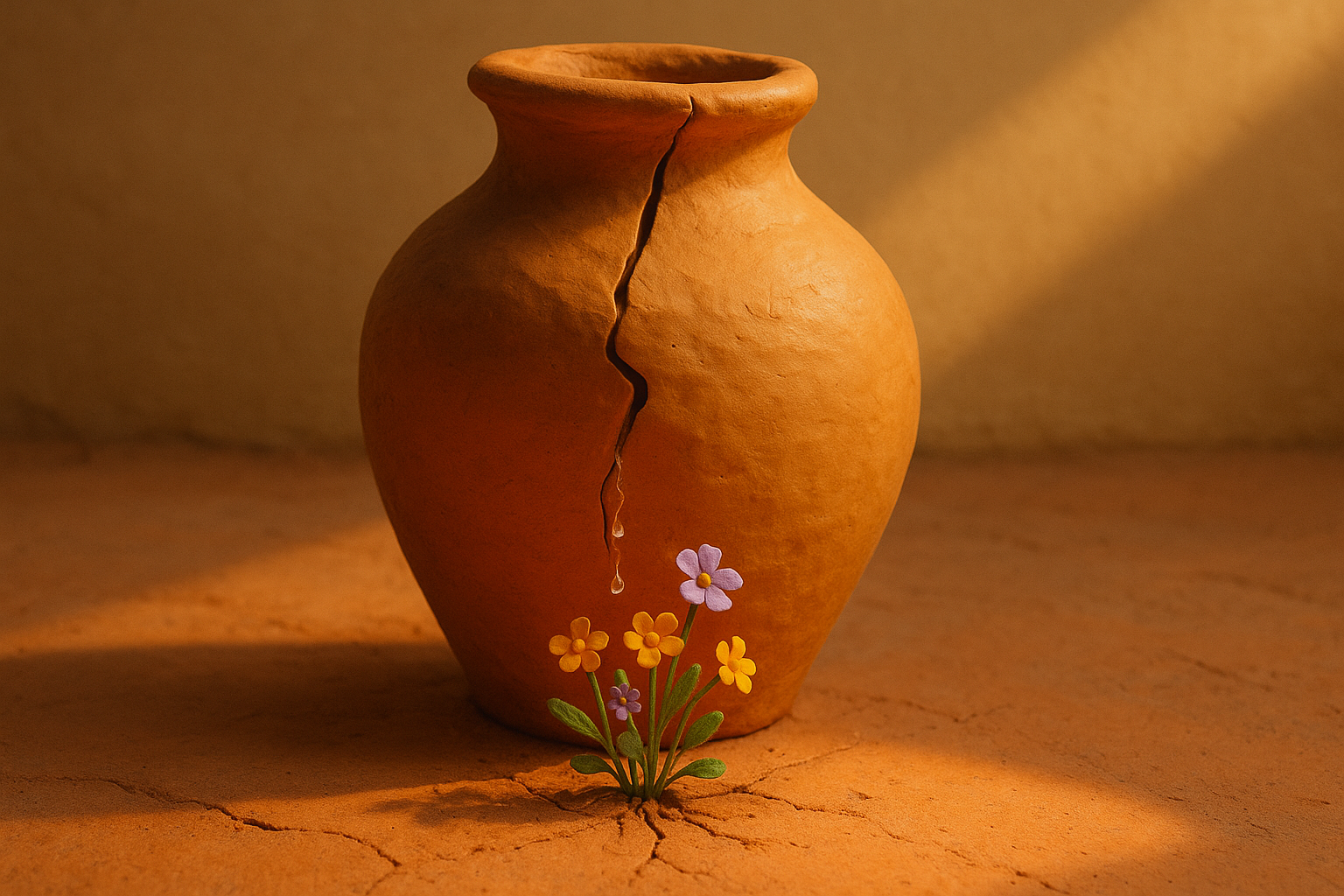
A water bearer carried two large pots to his master's house each day, one hanging from each end of a pole across his shoulders. One pot was flawless and arrived full. The other had a crack, and by the time the walk was over it held only half its water.
This went on for two years. The perfect pot was proud. The cracked pot was miserable — ashamed that it could deliver only half of what it was made to do.
One morning by the stream, the cracked pot finally spoke. "I'm ashamed of myself. I want to apologize. Because of my flaw, you do all this work and only get half the reward."
The bearer didn't argue. He said, "As we walk back today, notice the flowers along the path."
And the pot did. Up the hill, on its own side of the trail, wildflowers were blooming — bright and full. On the perfect pot's side, nothing.
"Did you notice the flowers are only on your side? I've always known about your crack. So I planted seeds along your path, and every day as we walk home, you water them. For two years I've picked those flowers to decorate my master's table. Without you being exactly as you are, there'd be no beauty in his house."
The lesson is quiet but it doesn't leave you: what you see as a flaw may be serving a purpose you can't perceive. The crack isn't just a leak. It's a channel.
The three moves hidden in the story
It's easy to read this as a warm little parable and move on. But there's real machinery underneath, and it maps almost too cleanly onto how we treat our own imperfections.
1. The pot assumed its flaw was only a cost
The cracked pot did the math the way we all do: I leak, therefore I subtract. Half a pot delivered means half a pot wasted. That accounting felt airtight — and it was completely wrong, because it only counted what spilled, never where it landed.
You do this too. You tally what your flaw costs you and never audit what it quietly produces. The person who "cares too much" is exhausting in meetings and also the reason the team ships work it's proud of. The one who "can't let things go" is anxious at 2 a.m. and also the one who catches the thing everyone else missed.
Rule of thumb: before you fix a flaw, find out what it's been secretly paying for.
2. The bearer designed around the crack instead of against it
Notice what the water bearer didn't do. He didn't buy a new pot. He didn't scold the old one or try to patch it. He looked at the leak, understood it wouldn't change, and planted a garden that only a leaking pot could grow.
That's the difference between fighting a trait and building around it. Most of the energy we spend on self-improvement is spent trying to become the perfect pot — plugging the crack, sanding the edge, being someone slightly less like ourselves. The rarer, smarter move is to arrange your life so the crack pours onto something worth growing.
3. The flowers only existed because of the flaw
This is the part that lingers. The perfect pot's side of the path was barren. Nothing grew there, because nothing spilled there. The flaw wasn't tolerated despite its cost — it was the entire reason for the beauty.
We're taught to treat imperfection as a tax we pay for being human. The story flips it: some of the best things in your life are downstream of the exact thing you'd erase if you could.
What this looks like when it's you
Abstractions are comfortable. The story bites harder when you make it concrete. So take the crack you already know about — the one that came to mind three paragraphs ago — and run it through the pot's questions.
| The pot's shame | The bearer's reframe |
|---|---|
| "I leak — I only deliver half." | "Where does the leak land, and what grows there?" |
| "I'm making your job harder." | "You've built a route that needs exactly this." |
| "The other pot is better than me." | "The other pot's path has no flowers." |
| "I should be fixed." | "You should be aimed." |
A few honest translations of "aimed instead of fixed":
- You're too sensitive to criticism — so you channel it into work where people feel what you make, instead of a job that grades you on thick skin.
- You can't sit still — so you stop apologizing for it and take the role that rewards restlessness instead of punishing it.
- You forget names and dates — so you build systems, and become weirdly good at making things that don't depend on memory.
None of these are lies you tell yourself to feel better. They're the actual water bearer's move: accepting the crack as permanent, then routing your life so it pours onto a garden.
The caution the story doesn't say out loud
This isn't a license to romanticize every failing. A crack that pours onto flowers is grace. A crack that pours onto your own foot is just a problem, and reframing won't fix it. The bearer's genius wasn't pretending the leak was fine — it was noticing where the water actually went, and taking responsibility for the terrain.
So the question isn't "is this flaw secretly good?" It's sharper than that: where is this trait currently pointed, and is that where I'd want it? Some cracks need a garden planted under them. Some just need to be pointed somewhere else.
Rule of thumb: don't ask whether your flaw is good or bad — ask where it's pouring, then move the flowers or move the pot.
You've been watering something the whole time
The cracked pot walked the same path for two years convinced it was a burden. The flowers were there the entire time. It just never turned its head to look at its own side of the trail.
That's the part worth carrying. Not that flaws are secretly virtues — that's too tidy. But that the thing you're most ashamed of has been in motion for years, doing something, leaving something behind you. Before you spend one more season trying to become the perfect pot, walk back up the hill and actually look at what's grown on your side of the path.
If this has you glancing back at your own side of the path to see what's been growing there, the Context Limit newsletter sends one story like this at a time — small enough to fit in your head.