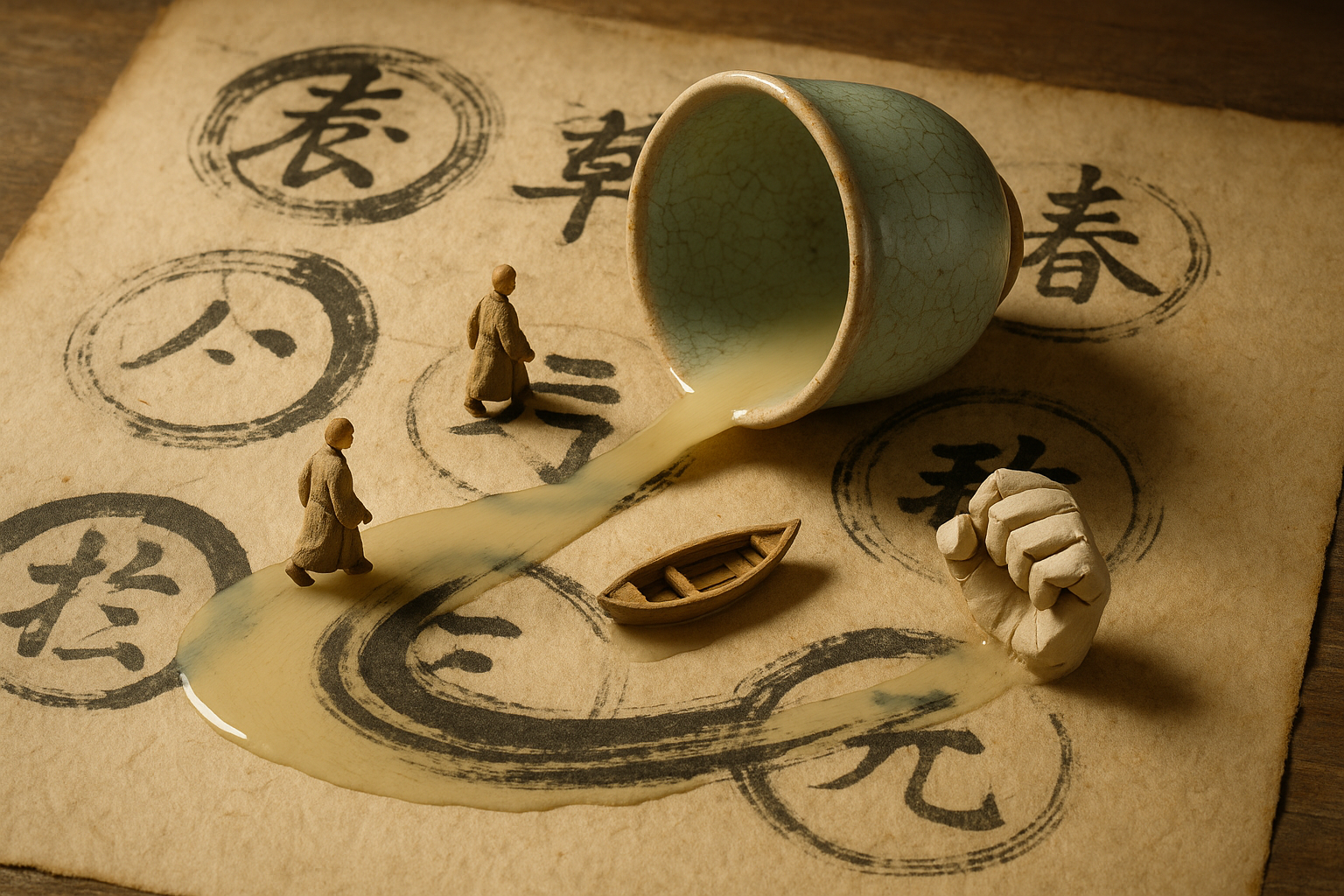
The ideas here draw on Words: Fables, Parables, and Wisdom for Modern Life — 200+ wisdom stories, organized by the moment in life you'll need them.
Tell someone to "just let it go" and watch their jaw tighten. It's the least useful advice ever given, because the person clenching a grudge already knows they should release it. Knowing was never the problem.
Stories work where advice fails. A good parable doesn't argue with you — it hands you an image, then steps back. You do the rest of the work yourself, which is the only kind of learning that ever sticks.
Below are nine short Zen and Taoist stories about letting go: of control, of outcomes, of grudges, of the need to be right. Each is retold briefly, with the lesson it carries. Read them slowly. The point isn't to collect them — it's to have one ready when you need it.
Why letting-go stories stick when direct advice bounces off
When you give someone advice, you put them on trial. "You should forgive him" implies they're currently doing forgiveness wrong. The defenses go up before the sentence finishes.
A story does the opposite. It's about a farmer, or two monks, or an empty boat — not about you. So you lower your guard. And somewhere in the middle you realize the story is about you, but by then you've already agreed with it. You caught your own reflection instead of being shoved in front of the mirror.
This is why every wisdom tradition runs on parables instead of policy manuals. The teaching survives the messenger. You can forget who told you and still remember the empty cup.
Rule of thumb: If you want a lesson to stick, don't state it — stage it. Give a person a scene to walk around in, not a conclusion to defend against.
1. The Empty Cup: you can't learn with a full one
A learned professor visits a Zen master to ask about Zen. As the master pours tea, the professor talks — about what he's read, what he thinks, what he already knows. The master keeps pouring. The cup fills, overflows, spills across the table.
"It's full!" the professor cries. "No more will go in!"
"Like this cup," the master says, "you are full of your own opinions. How can I show you Zen unless you first empty your cup?"
Letting go isn't only about grudges and grief. Sometimes it's about certainty — the quiet conviction that you already understand. That conviction is a full cup. Nothing new gets in.
Watch yourself in your next hard conversation. If you're rehearsing your rebuttal while the other person is still talking, your cup is full. You're not listening; you're waiting.
2. Is That So?: releasing the need to be proven right
A young woman in a village becomes pregnant and, under pressure, names the Zen master Hakuin as the father. The furious parents confront him. "Is that so?" he says. His reputation is destroyed. When the child is born, they bring it to him, and he raises it — begging milk and food from neighbors who now despise him.
A year later the woman can't bear the lie and confesses the real father. The parents rush back, apologizing, ashamed, taking the child. "Is that so?" Hakuin says, and hands the baby over.
He never argued. He never demanded to clear his name. He let the accusation land without absorbing it, and let the vindication arrive without gripping it. Most of us would have spent that year building a legal case in our heads.
The need to be proven right is a debt you take out against your own peace. The interest is every hour you spend rehearsing the verdict.
You can be innocent and calm at the same time. The two are only in tension when you make being seen as innocent the condition for your calm.
3. The Farmer's Horse: dropping the labels 'good' and 'bad'
A farmer's horse runs away. "How terrible," the neighbors say. "Maybe," says the farmer. The next day the horse returns, bringing three wild horses with it. "How wonderful!" "Maybe." His son tries to break one of the wild horses, is thrown, and shatters his leg. "How awful." "Maybe." The following week, army officers come through the village conscripting young men for war. They pass over the son because of his broken leg. "How lucky!" "Maybe."
The farmer isn't being coy. He's noticed something we forget hourly: we call events "good" and "bad" long before the story is finished. A layoff becomes the reason you started the company. A breakup becomes the space the right person walked into. You just can't see it from inside the moment.
Letting go, here, means loosening your grip on the label — holding your interpretation as a guess rather than a verdict. "Maybe" is one of the most spiritually advanced words in any language.
4. The Empty Boat: who are you actually angry at?
A man is rowing across a foggy river when another boat crashes into his. He turns, furious, ready to shout at the careless idiot who hit him. But the boat is empty — it broke loose from its mooring and drifted into him. His anger has nowhere to go. It simply dissolves.
Same collision. Same damage. But when there's no one to blame, the rage evaporates. Which means the rage was never really about the collision. It was about the person you imagined chose to wrong you.
The Taoist punchline is quietly devastating: most people who cross you are empty boats. They're tired, distracted, carrying something you can't see, moving through their own fog. They didn't aim at you. They just drifted.
Rule of thumb: Before you get angry at a person, ask whether you're actually angry at an empty boat. Most collisions aren't personal — they only feel that way because you were standing there.
5. Two Monks and the Woman: you can put the burden down
Two monks travel together and reach a muddy river crossing where a young woman stands, unable to cross without ruining her clothes. The older monk simply picks her up, carries her across, sets her down, and walks on.
Hours later, the younger monk is still stewing. Finally he bursts out: "We're not supposed to touch women! How could you carry her?"
The older monk replies, "I set her down at the river. Why are you still carrying her?"
This is the whole architecture of a grudge in one line. The event ended hours ago. The offense, the disappointment, the argument — it's over. But we keep hauling it, mile after mile, growing heavier while the world moves on.
You put a burden down the same way you'd put down anything: you notice you're holding it, and you open your hand. It's astonishing how often we simply forget that letting go is a physical option available at any second.
6. The Cracked Pot: making peace with the flaws you carry
A water-bearer carries two pots on a pole, one perfect and one cracked. Each day the cracked pot arrives half-empty, leaking water the whole way home. It's ashamed. Finally it apologizes to the bearer for being flawed and wasting half the water.
The bearer says: "Did you notice the flowers on your side of the path? Not on the other side. I knew about your crack, so I planted seeds on your side. Every day, you've watered them. For years, I've picked those flowers to decorate the table. Without you being exactly as you are, there'd be no beauty here."
Letting go isn't only about releasing external things. Sometimes the thing you're gripping hardest is the story that your flaw is only a deficit. The crack that leaks is also the crack that waters. The trait you'd surgically remove is often load-bearing for the parts of you people love.
7. This Too Shall Pass: holding every outcome loosely
A king asks his wise men for a single sentence, true in every situation, that will steady him whether he's at his highest or his lowest. They give him a ring engraved with four words: This too shall pass.
In grief, the words are a mercy — the weight will lift. In triumph, they're a warning — don't clutch this, it's already leaving. That's the genius of the phrase. It doesn't pick a side. It reminds you that every state you're in is on its way out, so gripping it is wasted effort either way.
Impermanence sounds bleak until you sit with it. If bad things pass, you can endure. If good things pass, you learn to actually taste them while they're here. The same truth that comforts you in the valley keeps you humble on the peak.
8. Bonus: The Tea Bowl That Was Already Broken
A student breaks a master's beloved tea bowl and, panicking, hides the shards. When the master approaches, the student asks a question first: "Master, why must all things die?" "It is natural," the master says. "Everything has its time. Nothing lasts forever." The student produces the broken pieces: "Then it was time for your bowl to die."
The story is a wink, but the teaching is real. We suffer most when we quietly expect exemptions from impermanence — everything ends, except this one thing I love. The bowl was always going to break someday. Loving it never required believing otherwise.
9. Bonus: The Muddy Water
A student asks how to find clarity when the mind is agitated and confused. The master points to a glass of muddy water and stirs it. "This is your mind now," he says. Then he sets it down. They sit in silence. Slowly, the sediment settles. The water clears — not because anyone worked on it, but because it was left alone.
Some things you don't fix. You let go of the stirring. Clarity isn't manufactured through effort; it arrives when you stop churning. The hardest form of letting go is often just leaving the glass on the table.
What these stories share
Read together, the pattern is unmistakable. Each story identifies a specific thing we grip too tightly, and quietly loosens our fingers.
| Story | What you're gripping | What it invites you to release |
|---|---|---|
| The Empty Cup | Your existing opinions | The certainty that blocks new learning |
| Is That So? | Your reputation | The need to be proven right |
| The Farmer's Horse | Your judgments | The labels "good" and "bad" |
| The Empty Boat | Your blame | The story that it was personal |
| Two Monks | Your grudge | The burden you keep carrying |
| The Cracked Pot | Your self-criticism | The shame about your flaws |
| This Too Shall Pass | Your current state | The illusion that it's permanent |
| The Broken Bowl | Your exemptions | The expectation that this one thing will last |
| The Muddy Water | Your effort | The urge to fix what only needs stillness |
Notice none of them tell you to stop caring. The farmer still farms. The water-bearer still carries water. Hakuin still raises the child. Letting go isn't detachment or indifference — it's caring fully about the thing in front of you while holding loosely to how it turns out.
How to reach for one in the moment
A story you read once and admired is decoration. A story you can summon under pressure is a tool. The difference is having a small vocabulary of them attached to the feelings that trigger them.
- Caught defending yourself? Reach for the empty cup. Ask whether you're listening or reloading.
- Desperate to be proven right? Reach for Is that so? The truth doesn't need your defense to stay true.
- Sure something is a disaster? Reach for the farmer. Add a "maybe."
- Furious at someone? Reach for the empty boat. Was it aimed, or did it drift?
- Still stewing hours later? Reach for the two monks. Set her down at the river.
- Ashamed of a flaw? Reach for the cracked pot. Look for the flowers it waters.
- High or low? Reach for the ring. This too shall pass.
You won't remember all nine in the heat of a moment. You don't need to. Keep two or three that match the things you actually struggle with, and let the rest wait until you need them.
Rule of thumb: Don't collect wisdom stories — assign them. Tie each one to a specific feeling, so the story shows up on its own when that feeling does.
If one of these ends up in your pocket — the empty boat on a bad day, or a quiet "maybe" when everyone else has already called it a disaster — there are more where they came from. I send one at a time in the Context Limit newsletter.